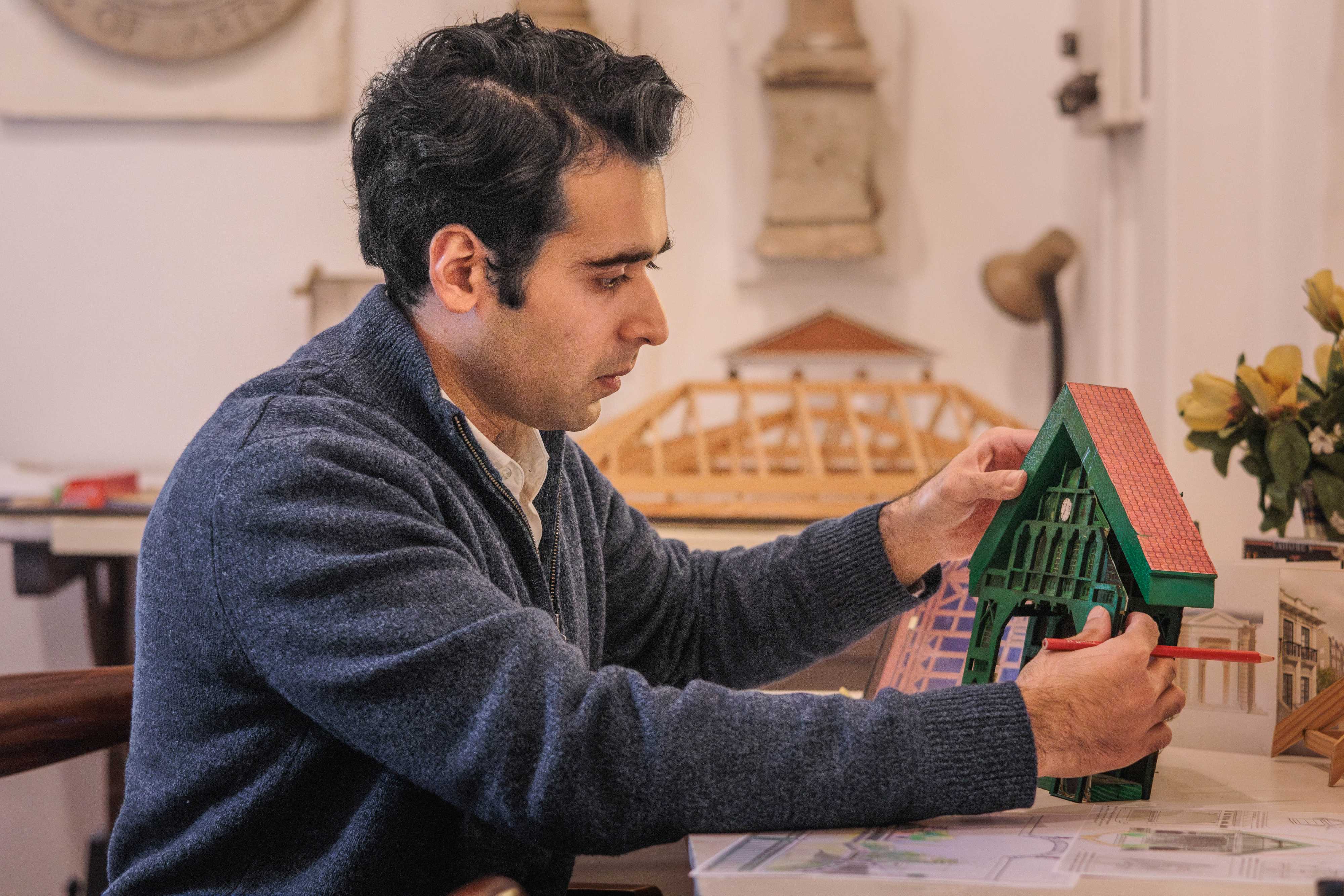
In Lahore’s historic Donald Town, a building from 1910 still hums with life, a rare survivor of a district once designed with a clear urban logic, where showrooms and workshops occupied the ground floor and residences for craftsmen and artists rose above. Here, allied crafts coexisted as a collective practice, a way of working that has largely vanished today.
Most of Donald Town has changed over time, but the Hayat family’s ancestral premises remain one of the few well-maintained and continuously active historic spaces in the area.

The building itself was constructed by their great-great-grandfather Mohammad Hayat and his brothers, skilled craftsmen and builders, and its layered organisation still guides how work is done: furniture and interiors at the front, administrative spaces slightly deeper, and fabrication and workshops at the rear. Upstairs, the architectural studio occupies a former plaster cast room, its original elements dating back to the Kipling era of the National College of Arts carefully preserved, even as the space has been adapted for contemporary architectural practice.

It is in this environment, part home, part workshop, part studio, that brothers Sharif, Karim, and Hassaan Hayat grew up, learning the language of craft, proportion, and making long before formal education. Discussions about furniture, interiors, art, and architecture were daily rituals, and hours spent in workshops observing, experimenting, and slowly participating formed the foundation of their design intuition. Their father, Faisal Hayat, nurtured these early lessons, introducing model making, interior design, and the careful reproduction of period furniture, while an in-house library built over generations provided a quiet, continuous education in arts and craft.

Educated at Aitchison College and later at the National College of Arts (NCA), the three brothers bring distinct but complementary approaches to HARCH (short for Hayats’ Architecture): Sharif is pragmatic and technically rigorous, Karim pursues clarity and proportion with an artist’s eye, and Hassaan navigates between the two, balancing technical realities with spatial experience. Together, they carry forward a century-spanning family legacy through architecture that is disciplined, measured, and deeply rooted in both history and place.

Reading Lahore’s Layers
The brothers approach architecture as a living language, letting Lahore’s streets, layers of history, and urban rhythms guide their work. They study the city carefully, paying attention to social patterns, architectural history, and the urban logic that has shaped daily life for generations.
“Lahore is a city shaped by layers of time, memory, and everyday life, and we try to read it carefully before intervening,” states Hassaan. “This grounding matters because the built fabric of Lahore has always supported dignified ways of living, spaces that were generous, adaptable, and deeply connected to the people who used them. Much of that quality is being eroded today by architecture that is visually loud but socially mute, disconnected from climate, culture, and lived experience.”

Practicing architecture in Lahore carries responsibility. Historic buildings and neighborhoods are under constant pressure, and architects either accelerate their loss or contribute to their continuity. For the brothers, this means respecting context, adding value rather than noise, and designing buildings that age well and remain meaningful over generations. Even small projects, when handled responsibly, contribute to the city’s collective memory and built fabric.

Classical Architecture as a Living Discipline
For the Hayat brothers, classical architecture is not nostalgia. It is a time-tested framework for proportion, scale, and human experience.
They explain that engaging classical architecture as a living discipline means treating it as a method…a way of thinking and building, rather than a visual style taken from the past. It provides clarity and discipline in how buildings are conceived and made, lessons that are more relevant than ever in a time that often prioritizes speed over care.
South Asia, they believe, has a rich architectural lineage that deserves study and continuation. At HARCH, classical architecture grounds contemporary work in centuries of knowledge, allowing buildings to feel rooted and meaningful while responding intelligently to modern needs.

Drawing as Inquiry
The young architects are also committed to research, documentation, and measured drawing, practices that have been overlooked in contemporary architectural education.
Hassaan explains: “Practices such as measured drawing were once fundamental to how architects understood buildings, yet they are now often overlooked. By sharing this work publicly, we hope to make these methods accessible again and demonstrate their relevance to contemporary practice. Measured drawing requires spending time with a building, understanding how it was put together, why certain materials were used, and how it has aged over time. This builds a deep, intuitive understanding of structure, proportion, and craft, which then becomes a reference point when we design. Often, we find that many present-day architectural problems have already been thoughtfully resolved in the past, and studying such precedents allows us to smartly adapt those solutions.”

The Lahore Gymkhana Cricket Pavilion is one such precedent, a finely crafted timber structure and rare example of large-scale timber construction in the subcontinent. Its clarity of structure, efficient use of material, and climatic responsiveness challenged assumptions about local building traditions and offered lessons in sustainability and craft that the brothers continue to apply in their work.

Making and Craft
In HARCH’s ancestral studio, architecture and craft coexist. Craftsmen, some of whom are descendants of the family’s original collaborators, work alongside the architects, sharing knowledge across generations. This continuity reinforces the brothers’ belief that making and designing cannot be separated, and that architecture gains depth when it is informed by hands-on craftsmanship.

Current projects reflect HARCH’s ethos; a residential project in Lahore’s DHA Phase 7 explores a more dignified model of suburban living, drawing lessons from the city’s older neighborhoods where proportions and everyday spaces were handled with care. They are also undertaking a sensitive extension to a Nayyar Ali Dada–designed residence, alongside custom interior projects like fully bespoke classical kitchens.

Each intervention, large or small, reflects a deliberate balance of heritage, study, and modernity, a practice in which every line drawn carries the weight of a legacy.
Brothers Sharif, Karim, and Hassaan are not just architects, they’re storytellers reading the city with patience and awe, translating centuries of craft into buildings that are thoughtful, and most of all, alive.


Leave a Reply